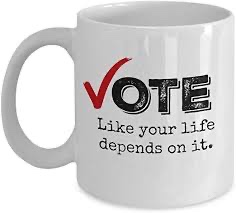
Why Your Vote May Not Matter (and the mug above is ironic…)
“Your vote counts.” “Vote to create your future” “A pandemic won’t stop me from voting.” Save the world. “Voting is you exercising your citizenship.” “The character of the nation is at stake.”
Your vote will (probably) be counted, but I am not certain it will matter. I am certain it won’t save the world, let alone democracy. And if voting is the only genuine exercise of the citizenry, we need a rehabilitated vision of citizenship. Creating your future is perhaps more contingent on the paradigm giving life to our current political environment. The pandemic is not what will stop me from voting – it is a paradigm that might stop me. And it is this paradigm that sufficiently reveals the character of our nation, not which candidate wins.
The decision for me is not about the moral repugnancy of a candidate, the incomprehensibility of a specific platform, or the choice between the lesser of two evils. The question in my mind revolves around the prevailing paradigm of political “engagement”. By paradigm I mean a clear and typical example or pattern. The current pattern in its unconscious presence and pervasive reach, seems to be entirely at odds with the stated values of citizenship, democracy in general, and perhaps most importantly, the flourishing of our common humanity.
What is the paradigm I am referring to?
The idea for me was introduced by Albert Borgmann in his 1984 work Technology and the Character of Contemporary Life. The book is a philosophical inquiry into the character of our contemporary life and sought to isolate and identify the “technological device paradigm.” Now, before I lose you with long words that sound utterly disconnected to the real world, this paradigm as put forward by Borgmann is simply the largely unconscious way a culture “takes up with the world.” To put it simply, Borgmann isolated a pattern of how we think about and relate to the world, specifically as it relates to the advances in technology. For me, this paradigm highlights my own discontent with our current political climate and prescribes possibilities of meaningful change. Interested? I will share a few illustrative examples of the paradigm in everyday life. Second, I will let Borgmann in his own words articulate the paradigm. Finally, I hope to make a few gestures toward how this paradigm is present in our current election cycle and why it should matter to you.
EXAMPLE 1: One of my favorite memories as a kid is cutting firewood. The crisp fall air chilling the ears and nose, the sound of crunching leaves underfoot, the search for the perfect tree to clear from the forest and thus maintain health for the forest and warmth for our family. This traditional way of heating a house from the central hearth is now easily replaced with central heat and A/C. The technological device paradigm is seen in this dramatic change that I take for granted everyday. The commodity in view is warmth, and it can be provided at the touch of a button, thanks thermostat. I am disburdened of work, responsibility, and the rigor of preparing a fire. The technological paradigm illuminated is the securing of a commodity and ensuring its availability (continuous warmth) while simultaneously losing touch with how this commodity is brought to me, disburdenment. The full bodied engagement, social network and experience, responsibility, skill, and rootedness in reality of choosing a tree, cutting it down, chopping it, stacking it, moving it, curing it, building a fire, maintaining it safely, is replaced with a button. This provides warmth and the internal mechanisms of how it is provided is largely out of view. No doubt, less labor for mere warmth, and most of us are grateful. The net result of this paradigm in this arena is the security of a commodity with increased disengagement and the dissolution of the social realities no longer needed to simply press a button. (In other words I don’t need my dad to show me how to press a button, thanks anyways dad.)
EXAMPLE 2: Another example, briefly, is the full bodied engaged reality of making music versus streaming it off Spotify. (Currently I am doing that…oops) One requires discipline, skill, practice, and is often a social experience. It is a commanding reality in Borgmann’s terms that draws forth full engagement of human faculties. In contrast, streaming music operates within an observable pattern that via technological means a commodity (music) can be secured and made available at the click of a button – while how it comes to my ears is largely incomprehensible to me. The event of making music, the skill of recording music, the full experience of the music made is reduced to an available product I can consume on-demand. In other words, the paradigm is expressed in the securing of a commodity, music, and disburdening the consumer of having to think or even know about its origin, the skill involved in its creation, etc. All of this to say that a multi-faceted human experience thick with meaning and social connection – making music or playing an instrument is stripped of that possibility of deep engagement when procured as a simple commodity that tech can offer you. The magic is that I click a button and get music. The issue I care about is less that I do this with music, but that I assume this pattern holds in each sphere of life. In other words, I begin to interact with all of reality from the basis of this paradigm.
So let me share a few thoughts directly from Borgmann’s work about the device paradigm.
- “Central heating plants, cars, and T.V. dinners are technological devices that have the function of procuring or making available a commodity such as warmth, transportation, or food. A commodity is available when it is at our disposal without burdening us in any way, i.e. when it is commodiously present, instantaneously, ubiquitously, safely, and easily. Availability in this sense requires that the machinery of a device be unobtrusive, i.e. concealed, dependable, foolproof.” (77)
- “Finally, one can provide an ontological account of the paradigm by showing how the device paradigm is serving as an implicit guiding pattern for the transformation of human existence and the world. Things in their depth yield to shallow commodities, and our once profound and manifold engagement with the world is reduced to narrow points of contact in labor and consumption.” (77)
- “It [Politics] will not be the realm where the crucial dimensions of our common life will be considered or altered. These are always and already determined by technology. Politics is merely the metadevice of the technological order… The calls for participatory democracy which are oblivious to the substance of politics and merely recommend new forms of transaction are pointless and will remain inconsequential. One may as well call for participation in pocket calculators. A calculator not only disburdens one of the intricacies of computation, it resists efforts at engagement. It is beyond our care, maintenance, and radical intervention…And so it is with politics within a technological society.” (113)
What about AMAZON?
Whatever commodity is desired the promise from Amazon is availability and the disburdenment of even leaving your home to make a purchase – in fact, it is as easy as one-click. The mechanisms, software code, engineering feats within their fulfillment centers allowing this amazing security and availability is largely ignored – unless one of the warehouses sits in front of your house (hard to miss). Now there are many issues in invoking Amazon, ethical, ecological, economic, etc. but here I am just highlighting the pervasive nature of the device paradigm. I hope to illuminate how this paradigm forms our perception of reality beyond just when we purchase a new bidet (hypothetical example). Specifically, Amazon as an instance of the paradigm moves each user to think of and interact with reality in terms of a foreground where commodities are to be secured and a background of machine and technological milieu that disburdens us of the work of securing the commodity, thus cutting traditional ties and leading to disengagement. In other words, Amazon can secure for us our preferred commodity with the least burden to us and this paradigm over time or in its ubiquitous presence forms our conception of how to be in the world and relate to others. Especially in politics.
So, that’s why your vote is a lot like an Amazon one-click purchase.
The technological device paradigm is the prevailing pattern in America of taking up with the world, even in the political arena. The conception of political engagement is constrained by this technological paradigm. How so?
Our current election model takes on the appearance of an Amazon wishlist or cart in its essential features. Secure for me this ideal: liberty, safety, productive economy, healthcare, etc. envisioned primarily as a securable commodity (not as a complex ideal or reality…) and I will vote for you. The discernible pattern even in politics aligns with the device paradigm in that it is a migration away from full engagement of things or people toward a passive consumption of a secured commodity requiring little engagement.
The challenge exists in a general populace totally formed and largely unaware of this operating mode of what constitutes reality and meaningful engagement with that reality. Our vote in this paradigm is simply the means to secure our desired commodities (an Amazon wishlist to the tune of pro-life/pro-choice or tax cuts/tax increases on the wealthy) in our preferred delivery method on our preferred timeline (shipping and date of arrival). Even as we surrender meaningful engagement or, more inanely, redefine civic participation as consumption in the device paradigm sanctioned by a political party, we lose the web of connections that make civic discourse even possible. As we are disburdened of the real work and choices in the securing of these commodities we settle for a reduced vision of political action and human engagement as a whole. The lasting consequence is disengagement in the real world of problems, solutions, compromises, interaction, discourse, and the possibility of a substantive discussion on what the good life really is. The net result seems to be increasingly shrill insistence on MY preferred commodities to be secured, while this mode of “engaging” with reality wars against the ideals of democracy. Now is there needed and meaningful engagement in the political realm? Absolutely. Injustice needs to be addressed. Thoughtful and careful policy needs to be passed. Real thought needs to be given to the god we call the economy. But where this “engagement” follows the easy contours of the device paradigm it will be largely ineffective, inconsequential, and in the long run lead to further alienation or disengagement.
So, what am I really saying? I saw a few posts today stating that the character of the country is at stake in this election. I recognize where this is coming from and in some important ways agree with the sentiment. However, the intended force of this motto is totally ironic. In fact, nothing is at stake except the increased opportunity to become more and more aware of what the prevailing character of our contemporary life is like. This election, if anything, is a window into the real character of our nation, which while wildly divided over many issues is naively unified in its unconscious acceptance of the device paradigm. While this device paradigm is the primary way we relate to the world, security of commodities, whether liberal flavor or conservative flavor, will continue to shape the ways we interact with reality toward disengagement, ease, ignorance, and apathy. This paradigm influences the ways we engage with reality and even conceive of political discourse and civic engagement much more than either party or their policies. And this is the paradigm largely operating in your subconscious because it is prevalent everywhere in your life – forming you. A thermostat. An IPhone. Amazon. And it is casting your vote in the shadow of an Amazon one-click purchase.
So, why write this little article? Frustration with the clarion calls to save the nation or character of the nation. My own disenchantment with the current political climate. Perhaps seeing this paradigmatic reality as missing from discussion in civic engagement. My hope is to bring a pattern of life familiar to all of us in everyday realities and choices we make into consciousness. (Or even better, just read Borgmann yourself!!!) Increased consciousness to me opens the horizon of possibility that perhaps together we could imagine an alternative paradigm for contemporary life. An alternative way of engaging in politics. Until then though, I am not voting for my preferred commodities. You totally can. But beware the pattern of our contemporary life that may mitigate the very ideals you are voting for. All of life is not to be treated as commoditizable, the life we long politicians to secure for us are not instantly or endlessly available products, peace and social cohesion is not a commodity that partisanship can deliver. Our formation into mature human beings with the possibility of exercising free choice is at stake in our complicity in this paradigm. I am still imagining what my vote could be for, but it will start with full embodied engagement. More like cutting wood than pushing a button, more like playing a piano than clicking to the next Indie Pop playlist, more like pursuing a game of basketball with friends than simple diversion through Netflix, more like trying to create more than we consume (thanks Andy Crouch). In fact, more like engaging with a real neighbor than making a one-click purchase. A vote for either candidate in our current environment is to me a yes vote for the continuation of this basic orienting paradigm that is entirely false and at odds with genuine human flourishing – at an individual or social level. You may disagree or think this pattern is overstated, but… maybe wait a few days to judge that. When half of America doesn’t get the commodities they voted to secure. Then let me know if you see a paradigm.
EDIT: Your vote very much does matter in a variety of ways. I wrote this post to highlight the tendency (device paradigm) of engaging in reality in a way that mirrors how we engage technological reality (mere commodity secured for us by largely unknown device or process leading to increased disengagement). This tendency seems to me more central to our current election cycle and also largely unobserved. The overstated subtitle and title are simply to compete with the grandiose headlines we receive everyday haha.
 To Be Human